

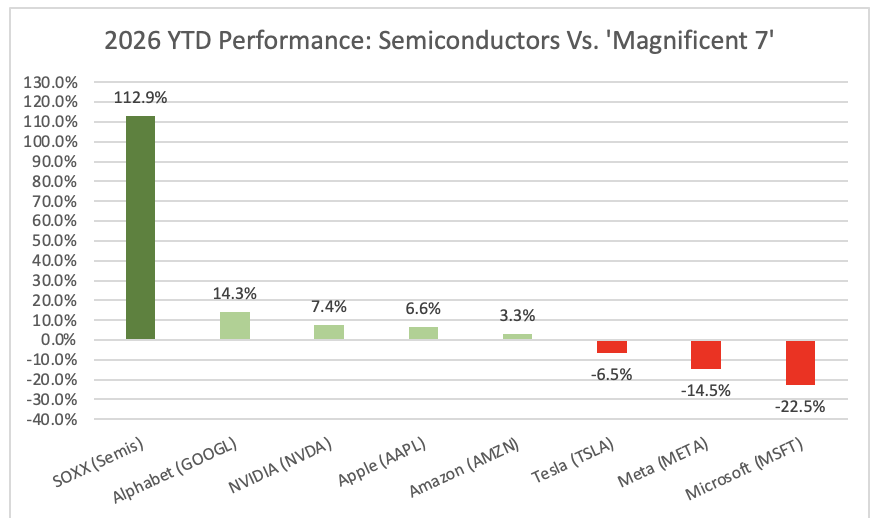
The Brentview Dividend Growth strategy returned 8.3% (gross) in the second quarter versus 15.2% for the S&P 500, our primary index. Markets absorbed the most severe energy shock since the 1970s, then delivered the strongest quarterly rallies since 2020 led by memory and chip stocks. As seen in Chart 1, the Philadelphia Semiconductor Index (SOXX), has appreciated 112.9% for 2026, mainly driven by the 95.3% jump during the second quarter, its best quarterly performance since the index was created in 1994. With Alphabet as the sole exception, the Magnificent Seven has trailed the S&P 500 index 10.2% year-to-date return, as investors have rewarded both semiconductor and memory manufactures, while punishing software businesses seen as vulnerable to AI disruption.
Chart 1
Source: FactSet Research
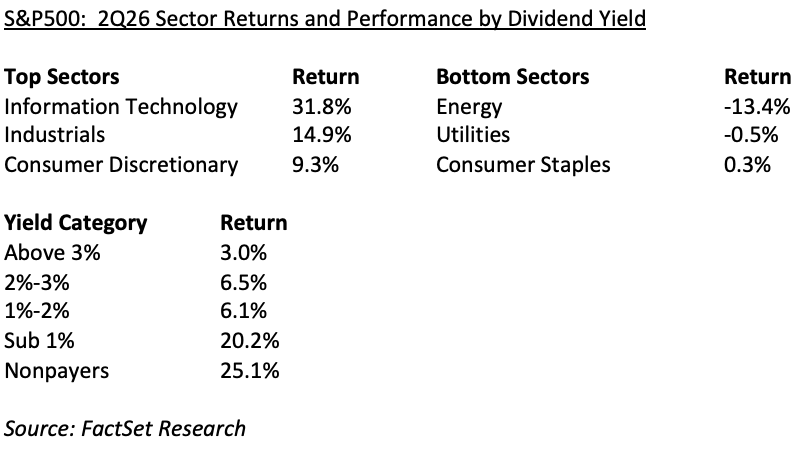
For the quarter, the strategy trailed the index by roughly 690 basis points. Sector allocation accounted for much of the gap, with stock selection a distant second. Two structural exposures explain most of it. First, non-dividend payers, a cohort our mandate excludes entirely, made up 16.7% of the index and returned 25.1% during the quarter. Second, our overweight in Energy and Utilities combined with our underweight in Information Technology placed a drag on relative performance as shown in Table 1. Oddly, memory stocks within Information Technology have become significant contributors to the R1000V, so not owning names such as Micron Technology was a value-style hindrance while not owning Nvidia was a growth-style obstacle.
Although our process was out-of-favor, stock selection produced some real bright spots. Lam Research gained 102.9%, riding record demand for the semiconductor equipment behind the AI buildout. Eli Lilly (+30.6%) benefited from accelerating earnings and expanding uses for its GLP-1 portfolio (Mounjaro and Zepbound), against a positive legal/regulatory backdrop. Morgan Stanley (+27.7%) delivered strong results, also against a positive regulatory backdrop, passing federal reserve stress tests which enabled them to hike the dividend by 15% and announce a $20 billion share buyback program.
Table 1
Monetary Policy
Introducing a profound wildcard into this repeating cycle is Kevin Warsh, who became the 17th Chairman of the Federal Reserve in May 2026. Warsh’s arrival marks a stark regime change from the highly transparent, heavily choreographed communication style of Jerome Powell. Instead, Warsh’s philosophy harkens back to the Alan Greenspan Fed, an era defined by strategic ambiguity and "Fed speak." Warsh has openly criticized the modern Fed's reliance on extensive forward guidance and the "dot plots," arguing that broadcasting every policy inclination in advance robs the central bank of flexibility and creates an unhealthy market dependency on a central bank safety net. He prefers less predictability, a smaller regulatory footprint, and a return to market discipline, wanting investors to analyze economic data themselves rather than parsing Fed speeches for promises.
This shift in style fundamentally alters how the Fed might navigate the current inflation threat. Under Powell, the markets were coddled with constant warnings of policy shifts. Under Warsh, the Fed is far less communicative and much more comfortable, leveraging the element of surprise. While Warsh has firmly signaled his commitment to price stability, indicating he will fight inflation aggressively and resist political pressure for easy rate cuts. However, his Greenspan-esque lack of transparency means the market will no longer have a clear roadmap. By intentional design, a less predictable Fed will likely introduce higher volatility, as Wall Street can no longer rely on pre-announced policy cushions to navigate macro shocks.
Economy & Market Outlook
For 2Q26, the estimated year-over-year earnings growth rate for the S&P 500 is 23.1%. If estimates hold, that will represent the second straight quarter of earnings growth above 20% for the index. The 5-year average earnings growth rate is 15.4%. Earnings appear to be driven by technology companies, contributing over 60% of overall earnings. The forward 12-month forward PE of the S&P 500 is 20.1x, cheaper now than in January 2026 as earnings growth estimates have accelerated. This is above the 5-year average of 19.9x and above the 10-year average of 19.0x.
Year to date, the S&P 500 index has returned 10.2%. This marks the third time in the past four years that the index has gained 10% or more in the first six months of the year. Historically, strong first half results were followed by additional gains in the second half. Along those lines, since 1980, there have been 19 years in which the index rose 10% for the first 6 months of those years where the index finished higher 89% of the time and averaged over 8%.
Dividend Growth
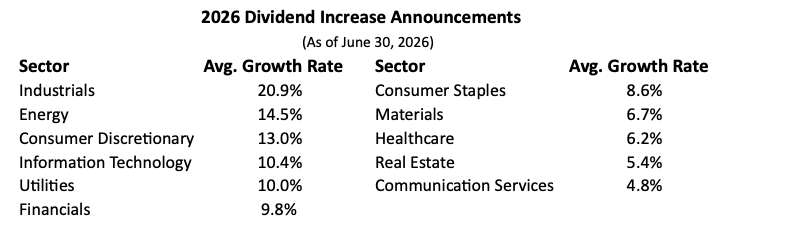
Last year, the S&P 500 index dividends grew by 5.5%. In 2026, dividends are expected to grow to 6.5% outpacing global dividend growth of 2.7% driven by robust corporate profits. As shown in Table 2, Brentview has found double digit growers in industrials, energy, consumer discretionary, information technology and utilities. Through 2Q, 22 of our 36 holdings (61%) announced dividend increases, averaging 10.7%. April was particularly busy with 6 companies announcing increases during the month. Standouts during the quarter included one of our Energy holdings, Targa Resources, which announced a 25% dividend increase. Other notable increase announcements included Morgan Stanley (15%), Costco (13%), and JP Morgan (10%).
Table 2
Portfolio Positioning
Brentview strives for a portfolio that can play both offense and defense, thereby providing an all-weather profile balanced across the dividend-yield spectrum and with all eleven sectors represented. We sold Medtronic, a higher yielding stock, over concerns about how cuts to medical funding were impacting hospital budgets and increased closures. We added to our technology hardware exposure by buying Taiwan Semiconductor Manufacturing Co., the go-to foundry for nearly every major chip designer. We remain cautious with consumer-facing businesses as inflation continues to squeeze household budgets.
This commentary reflects the views of Brentview Investment Management and is subject to change as market and other conditions warrant. No forecasts are guaranteed. This commentary is provided for informational purposes only and is not an endorsement of any security, sector, or index. The commentary should not be seen as a solicitation or offer to buy or sell any securities. The advisor (Brentview Investment Management, LLC), and their employees and clients, may hold or trade the securities mentioned in this commentary. Diversification does not guarantee a profit or eliminate the risk of a loss. PAST PERFORMANCE IS NOT A GUARANTEE OF FUTURE RESULTS.
If you would like to learn more about Brentview Investment Management and the Dividend Growth Strategy please, click here
 |
 |
 |